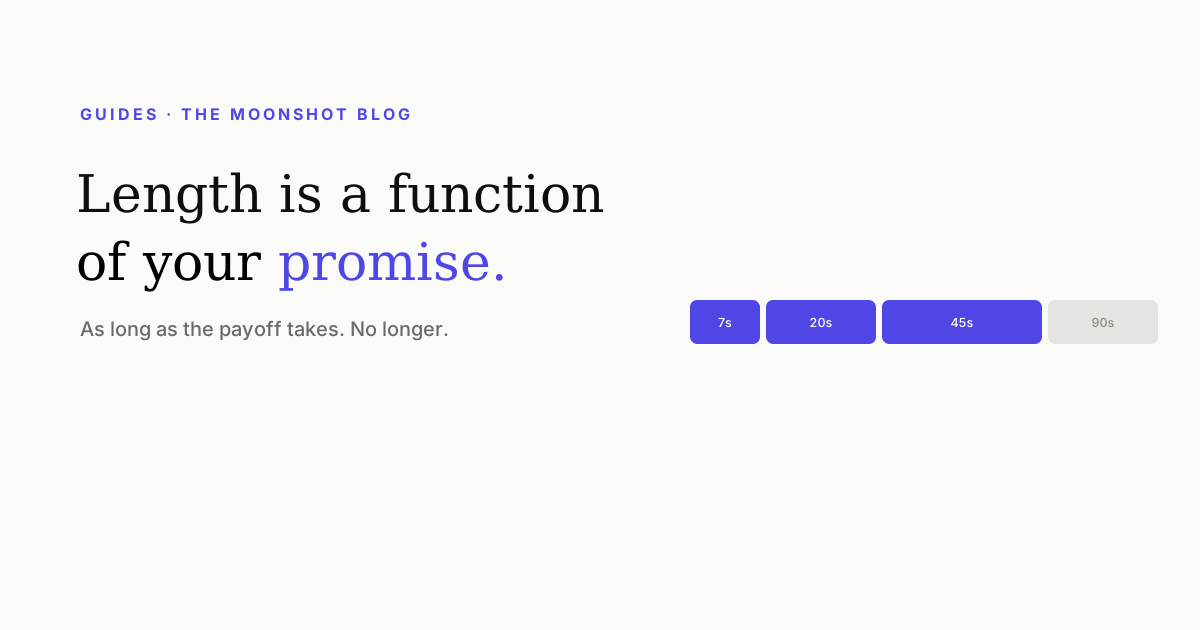
Every “optimal Reel length” article quotes a number, and the numbers disagree — because length isn’t an independent variable. What the platform actually rewards is the proportion of your clip that people watch, which is measured against your own runtime. Which means the real question isn’t how long to make it. It’s how big a promise you made.
Why a fixed number can’t be right
The signals that matter — completion rate, average watch time, whether people re-watch — are all relative to duration. Extend a clip and completion falls even if nothing else changed. Shorten it and completion rises without the content getting better. Any advice of the form “post 22-second Reels” is describing an artefact of that arithmetic.
What’s actually stable across clips is a rule about fit:
Length by promise size
| Promise | Typical range | Failure if you overrun |
|---|---|---|
| A single joke, image or reaction | 7–15 seconds | Explaining the joke |
| One idea, one example | 15–35 seconds | A second example nobody asked for |
| A genuine list (“three things”) | 35–60 seconds | Items four and five, which are always the weak ones |
| A story with a turn | 45–90 seconds | Setup that could have been one sentence |
| A process or demonstration | As long as the process | Real time instead of edited time |
Where the seconds actually are
Most clips are 20–30% longer than their content, and almost all of that lives in four places. Cutting here shortens the clip without shrinking the idea:
- The runway. Greetings, throat-clearing, “so today I wanted to talk about”. Usually three to five seconds, and the most expensive ones you own — see the cold open.
- Restating the point. Saying the thesis, explaining it, then saying it again. Once is enough.
- The second example. The first one carries the idea; the second is for you, not the viewer.
- The outro. “Anyway, let me know what you think, follow for more.” It converts nobody and it’s where completion goes to die.
The loop, and why very short clips flatter themselves
Short-form players loop. A seven-second clip that someone leaves after twenty seconds counts as several plays, and the numbers look extraordinary. That’s real distribution — loops are watch time — but it’s worth knowing what you’re reading, because a seven-second clip and a fifty-second clip aren’t comparable on completion at all.
If you do make very short clips, make them loop cleanly: end on something that leads back into the opening, so the second pass feels intentional rather than accidental.
When longer is genuinely better
- The content earns it. A story with a real turn holds people for 90 seconds in a way that no 20-second version can, and total watch time rewards it.
- You have a second hook. Longer clips survive on structure — an early payoff, then a new loop opened around ten seconds. Without that they lose people at the second cliff.
- You’re selling something considered. Sixty seconds of substance filters for people who actually care, which is worth more than reach for some accounts.
How to find your own number
- Take your last ten clips and plot runtime against average watch time — not against views.
- Look for the point where average watch time stops rising with runtime. That’s your audience’s patience with your format, and it’s more useful than any published figure.
- Then check the second cliff: if a lot of your loss happens around eight to ten seconds, the problem is structure, not length, and making clips shorter will hide it rather than fix it.
Quick answers
How long should a Reel be?
As long as the promise you made in the first three seconds takes to pay off, and not one second longer. That's usually 15–35 seconds for a single idea and 45–90 for a story or a genuine list. A universal 'optimal' number doesn't exist because the metric being optimised — the share of the clip people watch — depends on your own runtime.
Do shorter Reels get more reach?
Shorter clips find it easier to earn a high completion rate, and completion is a strong signal. But cutting a 60-second idea down to 20 doesn't produce a 20-second idea, it produces a confusing clip that gets abandoned — which is the opposite of the intended effect.
Is there a minimum length?
Practically, around seven seconds. Below that there isn't room for a hook plus a payoff, and very short clips loop so fast that the loop is doing the work rather than the content. If a clip is under seven seconds it should be because it's genuinely a single joke or image.
Does the algorithm prefer longer videos now?
Platforms have shifted toward total watch time over raw completion at various points, which rewards longer clips that hold people. That doesn't make length itself a strategy — a longer clip that loses viewers is worse on both metrics simultaneously.
Cut the runway, keep the idea
Editing by transcript makes trimming a clip a matter of deleting sentences — the fastest way to find the 20% of your runtime that isn't content.
Open Moonshot free