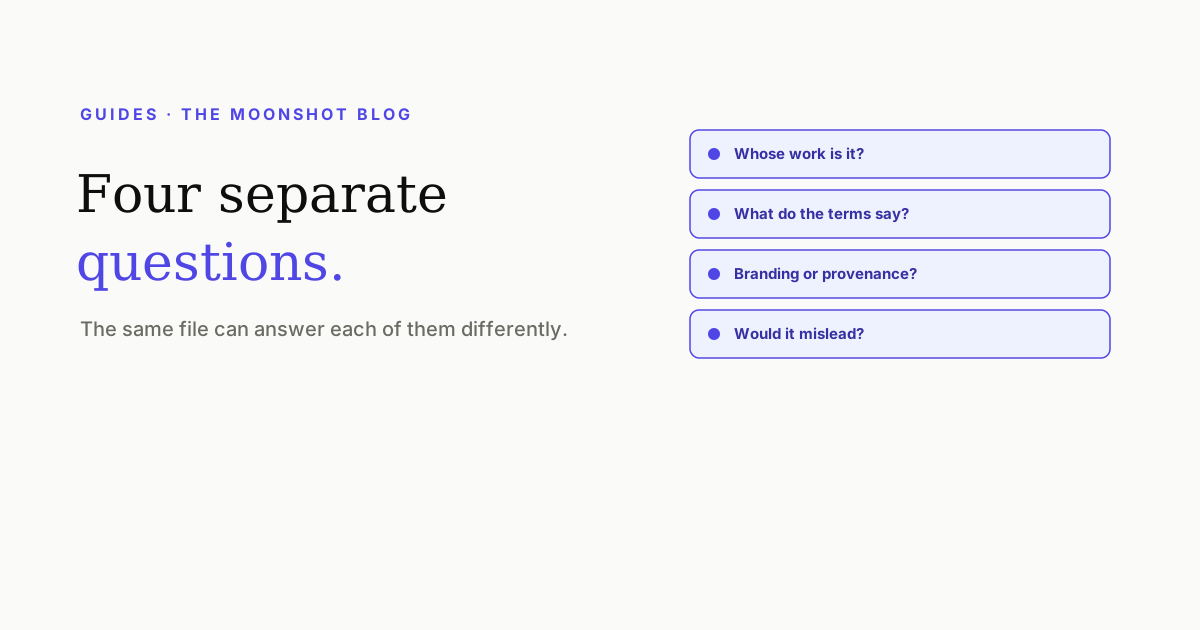
This question gets answered in one word by people selling tools and in another by people who haven’t thought about it. Both are wrong, because it isn’t one question — it’s four, and they can have different answers about the same file. Sorting them out takes about five minutes and is worth doing before you build anything on the result.
Question 1 — Whose work is it?
This is the one that decides most of the outcome, and it’s usually obvious.
| Situation | The honest read |
|---|---|
| A clip you generated, carrying the generator’s badge | The mark identifies the tool, not an author. Cleaning it is ordinary post-production — subject to that tool’s terms. |
| Footage you shot, with your own watermark | Yours entirely. |
| Someone else’s work, marked by them | No. The mark asserts authorship, and removing it to reuse the work is the problem the rules exist for. |
| A stock preview watermark | No. The mark is the paywall. |
| A client’s deliverable watermarked pending payment | No — that’s a contract question with a very clear answer. |
Question 2 — What do the tool’s terms say?
Separate from copyright entirely. When you generate a video with a service, you agree to its terms, and those terms can require attribution, prohibit removing the mark, or restrict commercial use of the output. Breaking them isn’t automatically a copyright matter — it’s a contract matter, with contract consequences like losing your account.
Terms also change, and they differ by tier: several services watermark free-tier output and provide clean exports on paid plans, which is itself a signal about how they view the mark. The five minutes it takes to check beats assuming.
Question 3 — Is it provenance rather than branding?
A logo in the corner says “made with X.” Provenance metadata — C2PA manifests, EXIF fields, invisible pixel-level signals — says “this content is synthetic.” These serve different purposes and deserve different treatment.
- Removing branding from your own generation is mostly an aesthetic decision.
- Stripping provenance is a disclosure decision, and disclosure rules for synthetic media are tightening in several jurisdictions — particularly around political content, advertising and anything depicting real people.
In practice they come off separately anyway: they live in different places in the file, which is the subject of the three layers article.
Question 4 — Would the result mislead anyone?
The test that catches most bad cases regardless of what the law says. Ask what a viewer would conclude from the cleaned file that they wouldn’t conclude from the original:
- “This wasn’t made with a particular tool” — trivial. Nobody is harmed by not knowing which generator you used.
- “This person made this”, when they didn’t — that’s the harm the whole apparatus exists to prevent.
- “This is a real photograph of a real event” — the case where disclosure is doing serious work, and where removing it can be genuinely damaging.
The short version
- Your own generations: generally fine to clean up, subject to the terms you agreed to.
- Your own footage: fine.
- Anyone else’s work: no.
- Stock previews: no.
- Provenance metadata: a separate decision, and one to make deliberately rather than as a side effect.
That’s also the policy we build to. Our video and image tools exist for the first two cases, and it’s worth saying plainly that they aren’t a way around the last three.
Quick answers
Is it legal to remove a watermark from an image?
It depends on whose image it is and why the mark is there. Removing a generator's badge from a clip you generated yourself is a very different act from stripping a mark off someone else's work in order to use it — and the second one is where both copyright and honesty problems live. This is general information, not legal advice.
Can I remove the watermark from an AI video I generated?
Generally the more defensible case: the mark identifies the generator rather than asserting anyone's authorship of the content. What still applies is the generator's own terms of service, which may say something specific about attribution and removal — those are contract terms, separate from copyright.
What about stock photo watermarks?
Don't. A stock preview watermark exists precisely because the image hasn't been licensed, so removing it is circumventing payment for a work you don't have rights to. It's the clearest 'no' in the whole area.
Does removing a visible watermark remove provenance metadata?
No, and this is a genuinely separate question. Visible marks, invisible pixel-level signals and file metadata such as C2PA live in three different places. Stripping provenance data can be a distinct issue from copyright, especially where the content could mislead someone about whether it's synthetic.
Clean the badge off your own generations
Detection, frame-by-frame tracking and inpainting for the Gemini, Veo, Sora, Kling, Runway, Pika and Luma marks — on clips you made.
Open the watermark remover